












There was a time when Roblox was just that—a game. Simple, blocky and easily accessible. All you needed was a Wi‑Fi connection and a half‑functioning school Chromebooks to escape into “Natural Disaster Survival” or meet friends in “Work at a Pizza Place.” Roblox wasn’t about graphics or mechanics. It was about presence: log in, join a friend’s server and lose track of time together.
But the platform that once defined a generation’s digital childhood is now making headlines for very different reasons. In recent months, Roblox Corporation has come under legal scrutiny for allegedly enabling minors to access third‑party gambling sites through its in‑game currency, Robux. The lawsuit is still unfolding, but the allegations raise a broader question: What happens when a platform built for children evolves faster than the children themselves?
For many users, Roblox wasn’t a pastime. It was a place—a shared environment that shifted as we grew.
“I used to play it with my cousins when we were little,” junior Liam Cabildo said. “It felt simple and fun. But now so many games are just about buying things or spending money. It’s like it stopped being a kids’ game and became a business.”
That shift is difficult to ignore. Today’s games are more polished, more complex and more commercial. Microtransactions are embedded into gameplay, and progression is often tied to spending.
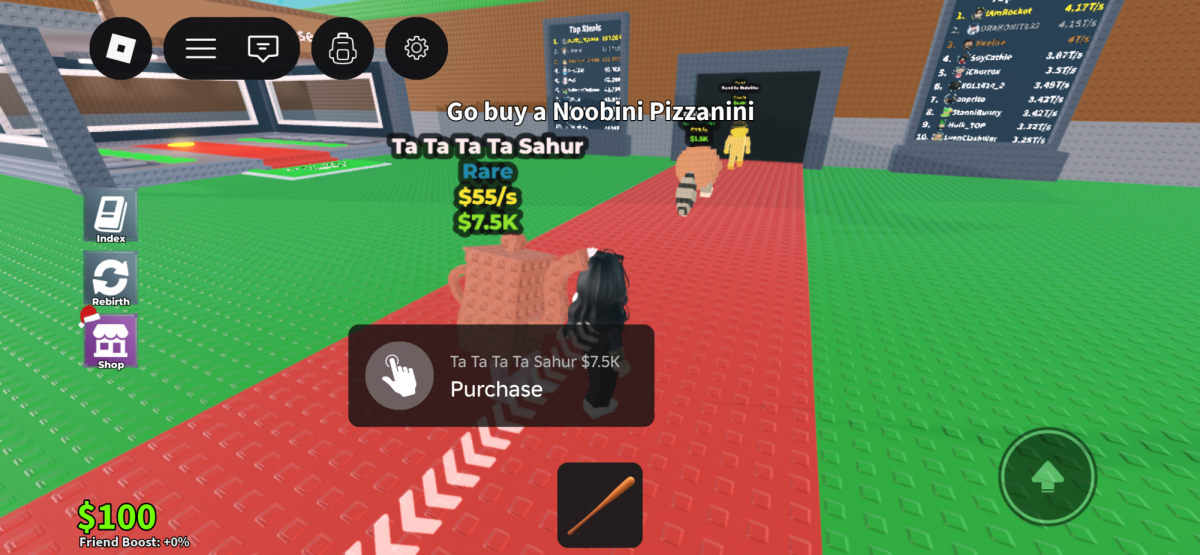
“Games like ‘Steal a Brainrot’ exploit kids’ minds by making it easier for them to spend Robux,” ninth grader Christine Ren said. “It’s less child‑friendly now than it was just a few years ago.”
Roblox isn’t inherently bad, but it feels different. What once functioned as a creative sandbox now resembles, at times, a marketplace with a game wrapped around it. For younger users who haven’t learned to pause before clicking “buy,” that distinction matters.
“It used to just be games,” ninth grader Ayden Su said. “It’s not like that anymore.”
Still, the platform hasn’t lost everything that made it meaningful. Roblox continues to offer a form of connection many relied on during isolation. During COVID lockdowns, I spent hours logged on—not because the games were exceptional, but because Roblox became a substitute for recess, a place to talk when there was nowhere else to go. Later, after long Model UN debates, friends would log on simply to unwind.
It was never about beating the game. It was always about who you were playing with.
“Bloxburg was my favorite,” junior Yashvi Gupta said. “It was a creative outlet. It even got me interested in engineering. To others it seemed boring, but for me, it was about building something with people I cared about.”
Now, when I log on, it’s mostly to humor younger cousins. They sprint through private servers, building elaborate tycoon bases and explaining viral games I can’t keep up with. I watch, slightly lost, as the controls feel unfamiliar and the pace moves faster than I remember.
Maybe Roblox didn’t change as much as it seems. Maybe we did.
Still, there’s something unsettling about watching a space that once felt like home grow into something unrecognizable. It isn’t nostalgia that makes the shift uncomfortable. It’s the awareness that millions of kids are growing up in digital spaces increasingly optimized for profit rather than play.
Roblox says it has moderation systems and safety tools in place, and to some extent, that’s true. But lawsuits like this point to a larger issue: the limits of self‑regulation on platforms designed for children but driven by adult economics.
Roblox taught many of us how to build, collaborate and socialize. It also taught us—perhaps too early—what happens when digital innocence collides with corporate scale.
And while many of us may have outgrown Roblox, the question that lingers is whether the platform ever planned to grow up with us—or simply past us.

Matthew • Dec 22, 2025 at 9:50 am
This makes so much sense, not only do game like Steal a Brainrot lure kids into buying stuff it also affects their emotions cause I know some kids that cry due to their brainrots being stolen and could cause them to not trust people in the future, cause of scammers being in those kinds of games,